


Home Spectrophotometer
Scanning UV Visible Spectrophotometer
Scanning UV Visible Spectrophotometer BHV1G1
Spectrophotometer
Scanning UV Visible Spectrophotometer
Scanning UV Visible Spectrophotometer BHV1G1
Spectrophotometer
Scanning UV Visible Spectrophotometer
Scanning UV Visible Spectrophotometer BHV1G1
Scanning UV Visible Spectrophotometer BHV1G1
Scanning Spectrophotometer- Sea, Air, Door to Door Shipping
- 1 Year Warranty
- US & European Standards

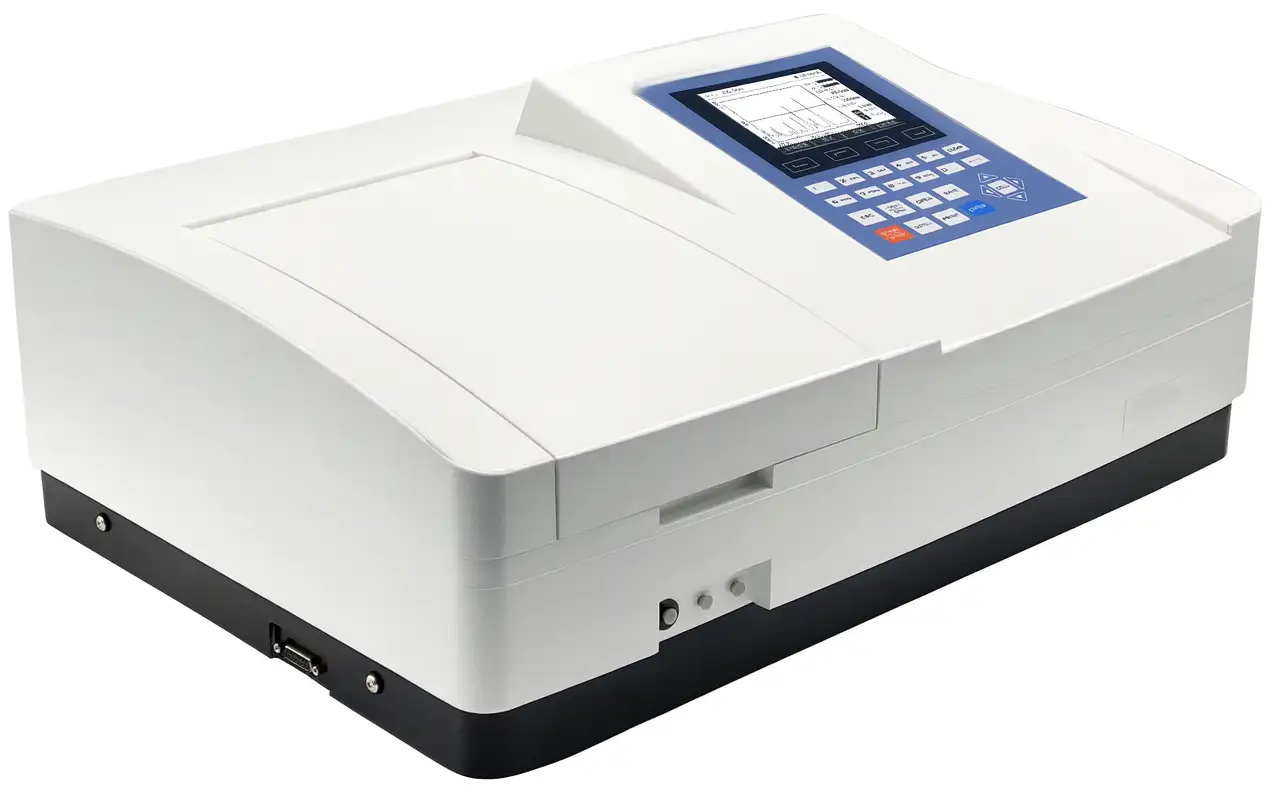
Specifications
| Model | BHV1G1 |
| Wavelength Range | 190-1100 nm |
| Spectral Bandwidth | 1 nm |
| Optical System | Single Beam Grating 1200 lines/mm |
| Wavelength Accuracy | ±0.3 nm |
| Wavelength Repeatability | 0.2 nm |
| Scan Speed | Hi, MED, LOW, MAX. 3000 nm/min |
| Photometric Accuracy | ±0.3%T or ±0.003A@1A |
| Photometric Range | 0-200%T, -0.3-3A, 0-9999Conc |
| Noise | ≤0.0001A @ 0.0A (500 nm, RMS) |
| Stray Light | 0.05%T @ 220 nm, 340 nm |
| Stability | 0.0008A/h @ 500 nm |
| Display | 5 inches LCD (320x240 dots) |
| Baseline Flatness | ±0.0015A |
| Standard Cell Holder | Standard 10 mm pathlength cuvette |
| Light Source | Tungsten & Deuterium lamp (Pre-aligned) |
| Output | USB Type A (USB memory, right side); USB Type B (PC connectivity, back); Parallel port for printer |
| Power Requirement | AC 110/220V 50/60Hz |
| Dimension (L*W*H) | 579x428x198 mm |
| Weight | 20 kg |
Description
It is an advanced single beam design, it provides excellent performance for measurements.It is suitable for clinical, pharmaceutical, and bio-chemical lab applications, as well as routine applications such as quantitative analysis, kinetics, Wavelength Scan, Multi-Wavelength and DNA/Protein analysis. The memory is 32K.
UV-Vis Analyst software Based Microsoft Windows makes these instruments versatile. All instruments provide excellent performance for measurements.
PC models
1.Online software update via the internet.
2.Data can be downloaded.
3.The PC models come standard with Windows based application software UV-Vis Analyst.
Features
Fixed bandwidths.Sealed, solvent-resistant tactile keypad with alpha-numeric entry for file names and units.
Pre-aligned deuterium lamp for easy lamp replacement. The status of the lamps may be monitored
PC Windows based software UV/Vis Analyst including sophisticated utility programs.
Data Download-to-PC software for stand-alone models (Optional)
Real-time clock for date and time stamping of results.
Data can be saved by a USB memory device directly.

USB memory port
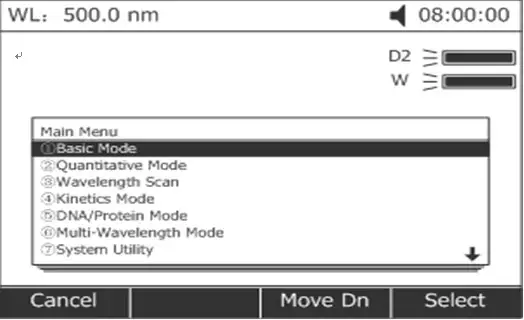
Brief Function Introduction:
All methods are included as built-in standard; this eliminates the need for software. Online software update via the internet.
The local control software includes functions such as: Photometry, Quantitative, Wavelength Scan, Kinetics, DNA/Protein, Multi-wavelength and System Utilities.
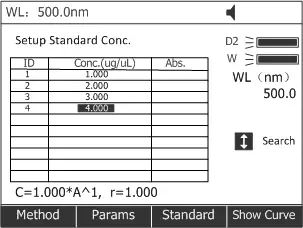
Standard Curve:
Up to 10 standard solutions may be used to establish a calibration equation curve. There is a choice of four methods for fitting a curve through the calibration points: Linear fit, Linear fit through zero, square fit and cubic fit.
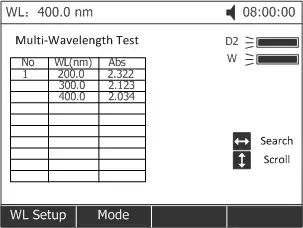
Multi-Wavelength:
Up to 10 wavelengths may be entered, allowing the measurement of multiple wavelengths on a series of samples.
Wavelength Scan:
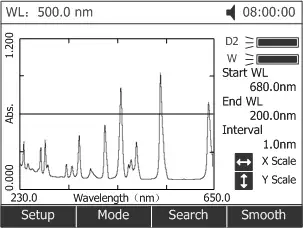
The Wavelength Scan intervals are 0.1, 0.2, 0.5, 1, 2, 5nm, and High, Medium and Low scan speeds are available. Scan speeds vary from 100 to 2000 nm/min. Wavelengths are scanned from high to low so that the instrument stands by at high wavelength. This minimizes the degradation of UV sensitive samples. Precise control of filter and lamp changes means that their effects are not seen on the final scan. Post-run manipulation includes re-scaling axes, curve tracking and peak picking.
Kinetics:
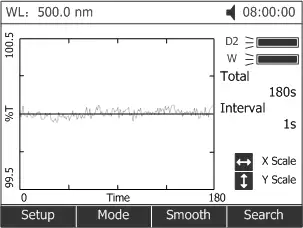
This mode may be used for scanning time courses or reacting rate calculations. Abs. vs. time graphs displayed on the screen in real time.
Wait time and measurement time up to 12 hours may be entered with time intervals of 0.5,1,2,5, 10, 30, seconds and 1 min.
Post-run manipulation includes re-scaling, curve tracking and selection of the part of the curve required for the rate calculation. Rate is calculated using a linear regression algorithm before multiplying by the entered factor.
DNA/Protein Test:
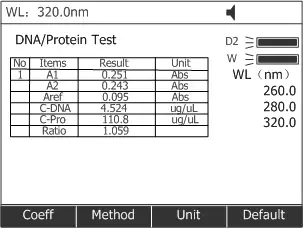
Concentration and DNA purity are calculated by
Absorbance ratios 260nm/280nm or 260nm/230nm with optional subtracted absorbance at 320nm
DNA Concentration=62.9*A260-36.0*A280
Or 49.1*A260-3.48*A230
Protein Concentration=1552*A260-757.3*A280
Or 183*A260-75.8*A230
Other wavelengths and factors may be entered.