
Get Quote ▼
Ducted Fume hood BFSD-201

- 1. UV lamp for sterilization.
- 2. resistant to weak acid and alkali.
- 3. Adjustable air speed: 9 levels.
- 4. Motorized front window, height adjustable.
- 5. Microprocessor control system, LED display.
- 6. With memory function in case of power-failure.
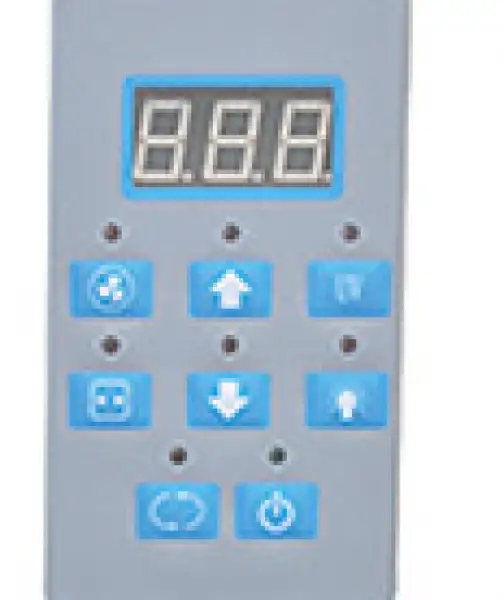
- LED Display
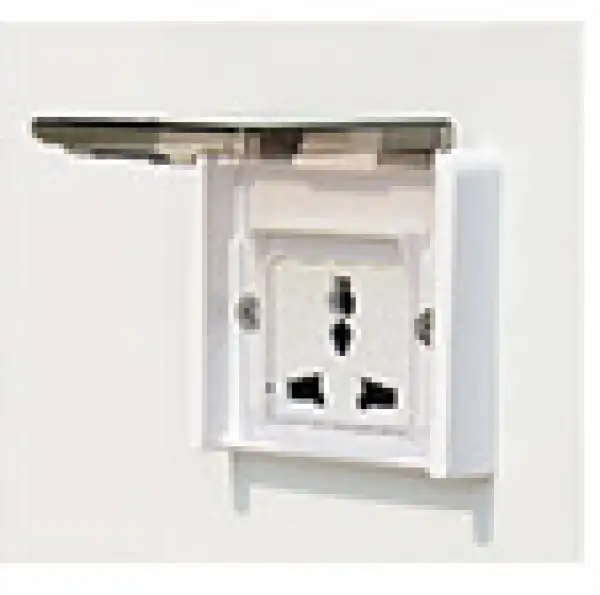
- Waterproof Socket
 Get Quote
Specifications
| Model | BFSD-201 |
| External Size (W*D*H) | 1040*800*2200mm |
| Internal Size (W*D*H) | 820*670*730mm |
| Work Surface Height | 850mm |
| Max Opening | 520mm |
| Air Velocity | 0.3~0.8m/s. |
| Noise | ≤68dB |
| Exhaust Duct | PVC, Standard length: 4 meters.Φ300mm |
| LED Lamp | 8W*1 |
| UV Lamp | Emission of 253.7 nanometers for most efficient decontamination |
| Blower | Built-in centrifugal blower; Speed adjustable |
| Front Window | 5mm toughened glass; Motorized; Height adjustable |
| Power Supply | AC220±10%, 50/60Hz; 110V±10%, 60Hz |
| Consumption | 400W |
| Exhaust Air Volume | 590 m³/h |
| Material Exterior | Cold-rolled steel with anti-bacteria powder coating. |
| Material Interior | 'Compact laminate board with good acid and alkali resistance function |
| Material Work Table | Chemical resistant phenolic resin |
| Standard Accessories | UV lamp*2, LED lamp, Water tap, Gas tap, Water sink, Base cabinetTotal load of 2 waterproof sockets: 500W4.3 meter PVC exhaust duct, pipe strap*2 |
| Optional Accessory | Active carbon filter, HEPA filter |
| Gross Weight | 286kg |
| Package Main Body | 1190*990*1690 mm |
| Package Base Cabinet | 1190*990*900mm |
Features
2. resistant to weak acid and alkali.
3. Adjustable air speed: 9 levels.
4. Motorized front window, height adjustable.
5. Microprocessor control system, LED display.
6. With memory function in case of power-failure.
LED Display
Waterproof Socket
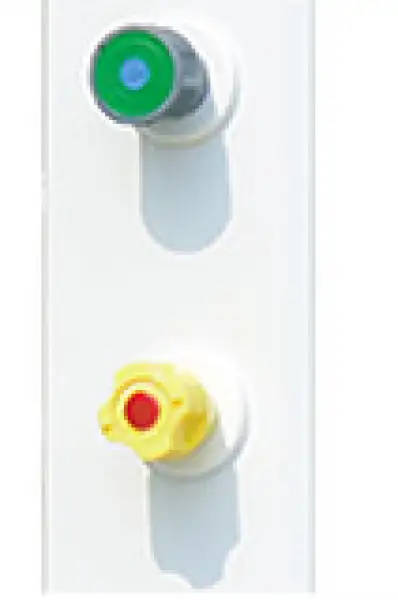
Water&Gas Remote Control
Double Layer, 1.2mm sheet metal surface, melamine board inward.
Operating Manuals
 Download Manual (PDF)
1. Unpacking, Installation and Debugging
1.1 Unpacking of Main Body
1.2 Unpacking of Base Cabinet
1.3 Accessories Checking
1.4 Installation Conditions and Operating Environment
1.5 Installation
1.6 Inspection after Installation
2. User Instructions
2.1 Functions
2.2 Product Structure
2.3 Control Panel
2.4 Instructions of Operation
2.5 Regular Maintenance
2.6 Wiring Diagram
3. Trouble Shooting and Labels
3.1 Common Failures and Solutions
3.2 Label Description
4. Warranty
1. Unpacking, Installation and Debugging
Please firstly check whether the packing box is in good condition. If the packing box is damaged, please take photos and contact the freight carrier. We are not responsible for shipping damages
1.1 Unpacking of Main Body
Choose a proper unpacking method according to the actual situation.
1.1.1 For wooden box
a) Method 1 Necessary tools for unpacking: Electric drill with hexagon dead M8
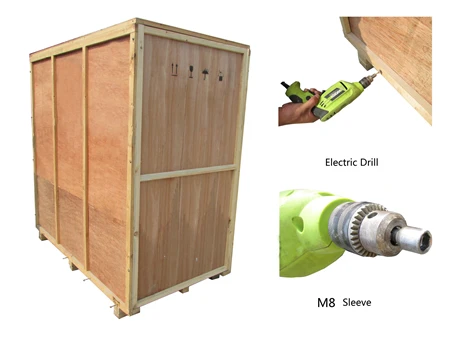
Figure 1
Method 2 Use M8 wrench to unpack
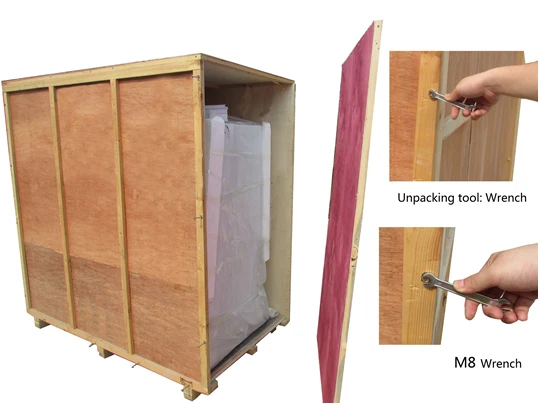
Figure 2
The following diagram demonstrates quick unpacking procedures (Picture 3). Remove the screws shown in the diagram below, then move the wooden pieces to right and left.
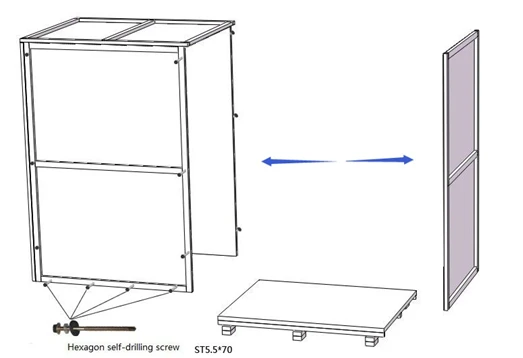
Figure 3
1.1.2 For cartoon box
Use scissor to cut the packing tape, take off the package cover, then move up the box body.
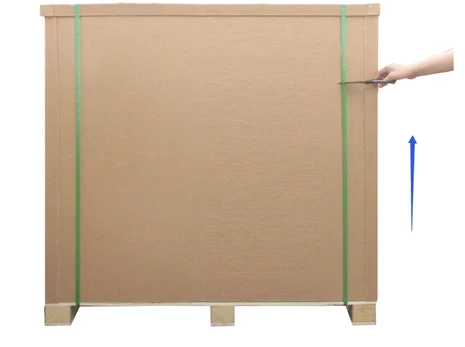
Figure 4
1.2 Unpacking of Base Cabinet
Choose a proper unpacking method according to the actual situation.
1.2.1 For wooden box
Please refer to the main body unpacking method (of wooden box) in the previous pages, use M8 electric drill or M8 wrench to remove the screws and unpack the box.
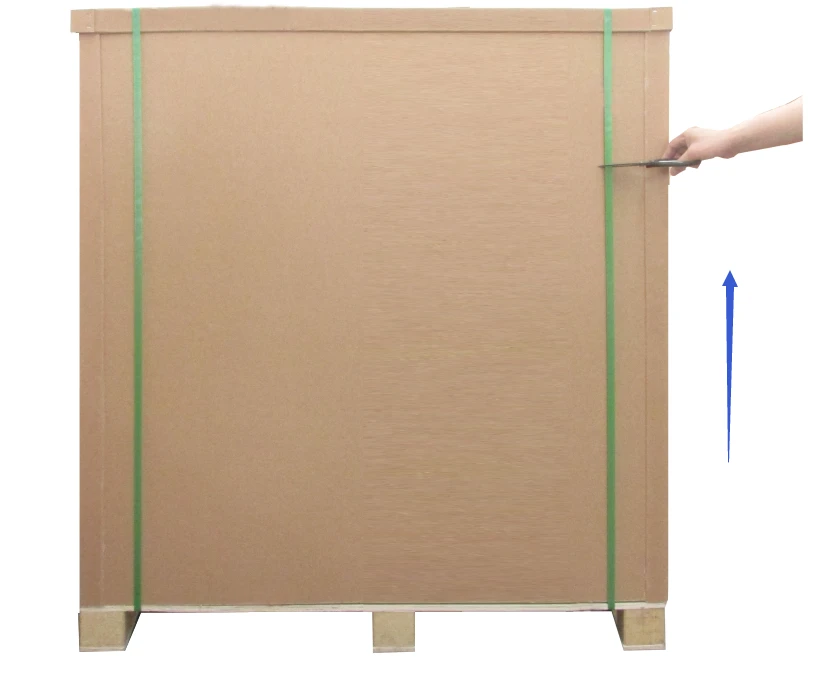
Figure 5
1.2.2 For cartoon box
Please refer to the main body unpacking method (of carton box) in the previous pages, use scissor to cut the packing tape, take off the package cover and move up the box body.
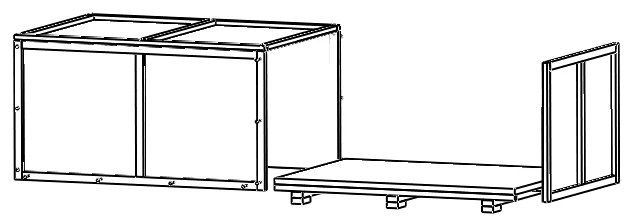
Figure 6
1.3 Accessories Checking
Accessories are placed inside the working area and base cabinet. Please refer to 1.5.6. to take out all accessories and check the completeness referring to this packing list.
Packing list ( Fume Hood)
Main body box:
No. | Items | Quantity |
1 | Main body | 1 unit |
2 | User manual | 1 pc |
3 | Certification of quality | 1 pc |
4 | Inspection report | 1 pc |
5 | UV lamp | 1 pc |
6 | Fuse (5A) | 1 pc |
7 | Fuse (10A) | 1 pc |
8 | Stainless steel hexagon socket head cap screw M10x20 Stainless steel hexagon nut M10 Stainless steel flat washer 10 and spring washer 10 | 4 sets |
9 | PP water sink with accessories | 1 set |
10 | Power cord | 1 pc |
11 | Motor control rod | 1 pc |
12 | Allen wrench | 1 pc |
Table 1
Base cabinet box:
No. | Items | Quantity |
1 | Base stand | 1 unit |
2 | Exhaust duct | 1 pc |
3 | Duct clamp | 1 pc |
Table 2
1.4 Installation Conditions and Operating Environment
1.4.1 Location requirements
To avoid disturbances to the Fume Hood and its operator, please follow the guideline below, while determining a suitable location for the equipment
a) Fume Hood should not be installed in positions where they are likely to be affected by other items or equipment. Windows, doorways, fans, room air supply diffuser or ventilation outlet should be away from the Fume Hood.
b) The distance from the front window to any circulation space or air-handling equipment should be at least 1000 mm, so as to preserve a zone undisturbed by anyone other than the operator
c) The position of a Fume Hood should satisfy the spatial requirements (e.g. vision, lighting and convenience of access) of the operator and personnel working nearby.
d) When a Fume Hood is installed on a bench top, the leading edge should be flush with or slightly overhanging the edge of the bench top.
1.4.2 Environment requirements
a) Only applicable to indoor operation
b) Ambient temperature: 15°C~35°C
c) Relative humidity: ≤75%
d) Atmospheric pressure range: 70 kPa~106 kPa
1.4.3 Electrical requirements
a) Electrical parameters: consistent with the rated voltage of the Fume Hood (See 2.1.4 Technical parameters and 2.1.5 Performance index)
b) Power supply need to be grounded (Judging method: test the live wire and the neutral wire of the main socket with multimeter. The voltage between live and ground should equal to the voltage of local electrical grid, and the voltage between neutral and ground should equal to 0. Otherwise, the power supply is not grounded correctly.)
c) Test the voltage stability before using. If the voltage is unstable, use a voltage regulator to adjust. Otherwise, the control panel and transformer may be easily damaged
1.5 Installation
1.5.1 Remove all the package materials
1.5.2 Check the surface of the base cabinet and the main body to make sure there is no scratch, deformation or foreign bodies
1.5.3. Move the whole equipment as close as possible to the final installation place.
 NOTE: Do NOT turnover, disassemble or slant the cabinet during transportation.
1.5.4 Position the base cabinet to the final location where an appropriate power supply is nearby; and brake the caster to stabilize the base cabinet
1.5.5 Make sure the voltage and frequency of power supply is same as the required value which is shown on the label. Take out the power cord from the packaging box and connect it with the female power cord connector on the main body. Plug in the other end to connect a power supply
1.5.6 Press the "  " button on the control panel to power on the equipment. Afterwards, press the "
  " button to raise the front window, take out the accessories from the operating area and remove the work table as shown in the picture below. Lastly, power off the equipment and prepare for installation.
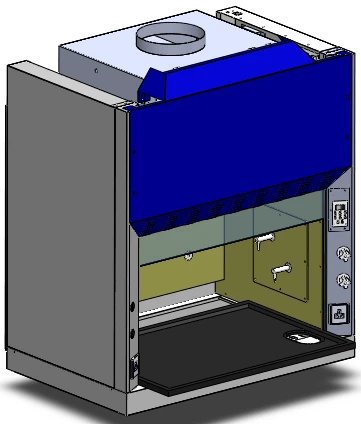
Figure 7
1.5.7 Connect base cabinet with main body
a) Lift the main body and place it on the base cabinet. Make sure each side is in alignment. Besides, please also make sure the mounting holes of bolt (as shown in Picture 9) at the bottom of the main body are in alignment with the holes on the top plate of the base cabinet
b) Make sure the main body and base cabinet are stable enough to prevent side-slip. Open the doors of the base cabinet and take out the components from the accessory bag
Stainless steel hexagon socket head cap screw M10x20
Stainless steel hexagon nut M10
Stainless steel flat washer 10 and spring washer 10
Insert the hexagon socket head cap screws (M10x20) into the holes at the bottom of the main body (refer to the Picture 8). These screws should pass through the main body and the base cabinet. Use flat washer 10, spring washer 10 and nut M10 to fasten the screws and nuts. Make sure the base cabinet is well connected with the main body.
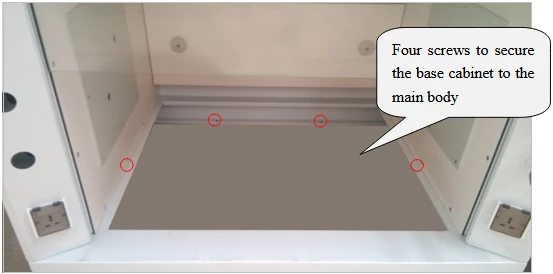
Figure 8
1.5.8 Installation of water tap and gas tap
Insert the work table and mount the water sink on the reserved sink hole.
Connect the laboratory water pipe and gas pipe (inflow) with the lower end of the taps.
Pass the drainpipe (provided) through the reserved hole at the side of the base cabinet (refer to Picture 10) and connect it with the sewer pipe in the laboratory room (water sink and drainpipe have been connected in factory)
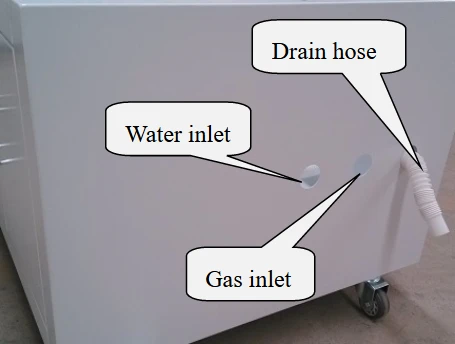
Figure 9
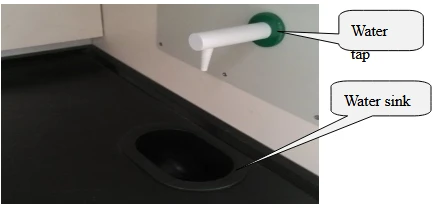
Figure 10
1.5.9 Installation of exhaust duct
Take out the duct clamp and the exhaust duct. Put the clamp on the exhaust duct and then connect the exhaust duct with the air exhaust outlet on top of the Fume Hood. Afterwards, use Slotted screwdriver to fasten the duct clamp firmly. The other end of the exhaust duct should be fixed outside the laboratory room and in the open air.
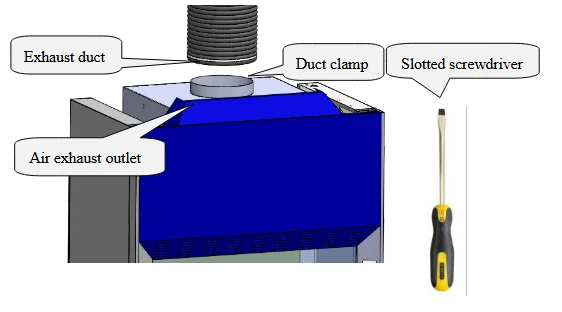
Figure 11
1.6 Inspection after Installation
Refer to this table and follow the instruction in 2.4.2, check the following items after powering on the Fume Hood.
Checking Items | Normal working status |
Power status | Equipment could be powered on/switched off when press the power button |
Fan | Runs normally after pressing the Fan button; speed could be adjusted by pressing the adjusting button |
Front window | Front window could be moved smoothly by pressing the UP and DOWN buttons |
Fluorescent lamp | Lamp lights up after pressing button |
UV Lamp | Lamp lights up after pressing button |
Socket | Use multimeter to test voltage output after pressing the socket button |
Table 3
NOTE: Please contact Biobase technical department or agent for inspection or trouble shooting when problems could not be solved. Methodology of trouble shooting is stated in the After-sale Service Manual.
2. User Instructions
2.1 Functions
2.1.1 Product concept
This product belongs to Fume Hood. Fume Hood is a kind of negative pressure ventilation system for protecting operator and laboratory environment. Room air flows inward from the front opening of the Fume Hood and is consistently ventilated by the extract blower. Therefore, contaminated fumes, vapors, toxic gasses, aerosol and corrosive substance which are probably generated during experiments could be prevented from spreading to the operator or into the laboratory room. In addition, the polluted air could be purified by the active carbon filter (optional) before exhausting through the duct. Thus, the outdoor environment could also be protected.
NOTE: Experiments with the use of flammable, explosive substances and strong acids or bases should NOT be conducted by this Fume Hood.
2.1.2 Operating principle/air flow pattern
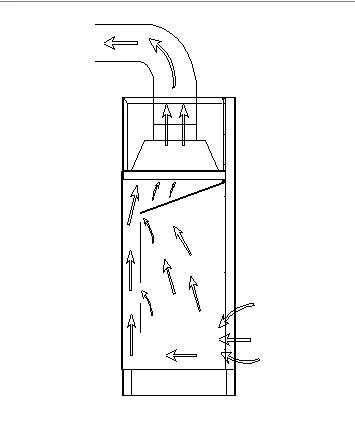
Figure 12
2.1.3 Protected object
The primary goal of the Fume Hood is to protect operators and laboratory environment from exposure to infectious aerosol and toxic fumes which may be generated from the reaction during experiments.
2.1.4 Technical parameters
Model Parameter | BFSD-201 | BFSD-202 |
Rated Voltage AC | 220V±10% 110V±10% | 220V±10% 110V±10% |
Rated Frequency | 50 Hz 60Hz | 50 Hz 60Hz |
External Dimension (W*D*H) | 1040*800*2200 mm | 1240*800*2200 mm |
Working Zone Dimension (W*D*H) | 820*670*730 mm | 1020*670*730 mm |
Power Supply Consumption | 400 W | 400 W |
Inflow Velocity | 0.3~0.8m/s | 0.3~0.8m/s |
Maximum Opening | 520mm | 520mm |
UV Lamp Consumption | 20W | 20W |
Fluorescent Lamp Consumption | T5 8W | T5 12W |
Noise | ≤70dB(A) | ≤70dB(A) |
Table 4
NOTE: a) Power supply consumption includes the consumption loaded at working zone, which should not exceed 500W.
b) Biobase reserves the right to make changes in future product design, without reservation and without notification to its users.
2.1.5. Performance index
a) Vibration amplitude
The net vibration amplitude, at a range of frequency from 10 Hz to 10 KHz, would not exceed 5 μm (rms)
b) Illumination
The average illumination would not less than 400 lux. Tested real illumination would not less than 350 lux
c) Electrical performance
Dielectric Withstand Test: the Fume Hood would not breakdown in 5s when the voltage increases by 1390V (AC) within 5s
Ground resistance ≤0.1Ω
2.2 Product Structure
2.2.1 Structural composition of Fume Hood
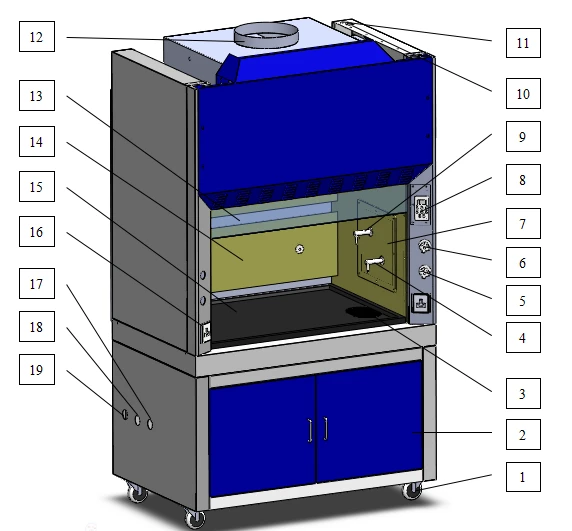
Figure 13
1. Caster
2. Base cabinet
3. Water sink
4. Water tap
5. Water tap control knob
6. Gas tap control knob
7. Access panel
8. Control panel
9. Gas tap
10. Power socket
11. Fuse holder
12. Exhaust outlet
13. Front window
14. Phenolic compact laminate
15. Work table
16. Socket
17. Gas inlet
18. Water inlet
19. Drain hose
2.2.2 Structure introduction
a) Driving system of front window
Driving system consists of tubular motor, front window and hauling mechanism (hauling sash)
b) UV lamp
The entire work zone could be sterilized effectively by the UV lamp located at the top of work zone. Emission of 253.7 nanometers could ensure the most efficient decontamination.
c) Fluorescent light
The Fume Hood is equipped with LED lamp tube, which ensures the standard requirement of average illumination (400 lux) is met. The measured value at any point inside the working zone should be greater than 350 lux.
d) Socket
Socket, located at the two sides beside the front opening, could supply electricity power for devices used in experiments and could be controlled by the  button.
NOTE: Please make sure the total load of sockets should be ≤ 500W.
e) Fuse protector
Fuse holders are installed on the top right of the equipment (refer to Figure 13).
Fuse of live wire is inside the female power cord connector. Socket (working zone) fuse holder and neutral wire (power source) fuse holder is beside the female connector . The specification of each fuse tube complies with the label right below the fuse holder. Please refer to the label when replace the fuse tube.
f) Structure
i. External case body adopted 1.0 mm cold-rolled steel in double layer structure with electrostatic coating and rust-proof treatment. The structural strength and stability are enhanced.
ii. Inner wall of work area is fully made of Phenolic Compact Laminate which provides corrosion resistance as well as attractive appearance; work table is made of solid chemical resistant laminate which is easy to clean and wash.
iii. Fume hood front window adopted 5 mm toughened glass.
iv. Control panel adopted soft-touch buttons and microprocessor control system that make the operation easily to be controlled
v. The electronic control system could prevent overload of the circuit and electric shock, stabilize the performance, protect the equipment and extend the use life of the Fume Hood.
vi. The sockets (at working zone) adopted non-flammable PC material that is specialized for laboratory use
2.3 Control Panel
2.3.1 Soft touch buttons
Main functions could all be executed by pressing the relevant button. There are totally 8 common buttons on the control panel (refer to Picture 14). The indicator light above each button shows the working status of the relevant function. The small LED display shows the speed level of the blower.
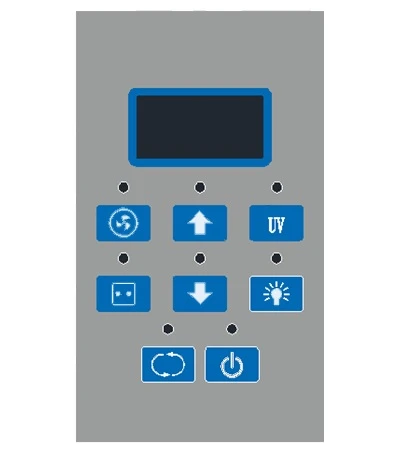
Figure 14
Power button, the main switch of the Fume Hood
 Fluorescent lamp, press to turn on the light, interlocked with UV lamp
 UV lamp, only works when both the blower and the fluorescent lamp are turned off
Front window up, press and hold to continuously raise the window
 Blower (Fan), press to turn on the blower, interlocked with UV lamp
 Front window down, press and hold to continuously lower the window
 Socket power, press to activate the sockets in the working zone
 Adjust fan speed, press to adjust the speed of the blower (fan) from F1 to F9
2.3.2 Control of the front window
The height of the front window could be adjusted by pressing the and buttons. The window will be moved continuously when pressing the button and it will stop moving immediately when the button is released. Please make sure the height of the front window is within the safety height range (520 mm).
2.3.3 Control of the fan speed
The blower (fan) could be turned on by pressing button (only when the UV lamp is turned off). The speed of the fan could be adjusted by pressing button. 9 speed levels could be selected. The relevant speed level would be displayed on the LED screen.
When turn off the blower or power off the Fume Hood, the level of fan speed is memorized by the equipment and would be resumed when turn on the blower again.
2.3.4 UV sterilization
UV light could be turned on by pressing the UV button. Please make sure the window is fully closed before starting UV sterilization. Interlock function was adopted between UV light and the blower/fluorescent light. UV light could be automatically turned off when either the blower or fluorescent light is turned on. During sterilization, people should leave the room for safety of eyes and skin.
2.4 Instructions of Operation
2.4.1 Normal Operation Notice
a) Make sure input voltage is correct and stable. The rated load of main power socket should be higher than cabinet consumption. Plug must be well grounded.
b) The equipment should be powered off and unplugged before doing any replacement of parts, such as UV lamp and fluorescent lamp.
c) The front window is made of explosion-proof toughened glass. In order to keep the front window clean and clear, please wipe it by wet soft cloth and keep it away from hydrofluoric acid
d) The air deflector and other internal accessories should be cleaned according to the use of the Fume Hood
e) The air duct and the blower of the Fume Hood should be cleaned and maintained regularly in a proper way
f) Fume Hood should be placed in a position where there should be no other equipment or machine within 150mm of the front window
g) Do NOT place any soft or tiny materials (such as soft tissue) on the work table during the operation to prevent breakdown of the blower causing by sucking those materials
h) The packed Fume Hood should be stored in a warehouse with relative humidity no more than 75% and temperature lower than 40°C. The warehouse should have good ventilation performance without acid, alkali or other corrosive gases
i) The maximum storage period is one year. A performance inspection should be done if the storage period exceeds one year
NOTE: BIOBASE WILL NOT BE LIABLE FOR ANY RISK OR DAMAGE ARISING FROM YOUR FAILURE TO APPROPRIATELY OPERATION THE FUME HOOD!
2.4.2 Operation Process
a) Connect to a suitable power supply
b) Power on the Fume Hood by pressing the power switch under the working zone, the LED screen would be lighted as "  "
"
c) Press the POWER button on the control panel to enable all functions (fluorescent lamp, UV lamp, blower, socket, front window). The LED screen would display the accumulated operating time of the blower (if the optional active carbon filter is ordered and equipped, the LED screen would display the accumulated operating time of the filter).
NOTE: The displayed figure needs to multiply by 10 to get the actual operating time. The unit is hour.
d) Press the UP button to raise the front window to a proper height. Please refer to 2.1.4 for the maximum opening of the front window
e) Press the FAN button to turn on the blower. The LED screen would display the speed level of the fan memorized from the last time of operation. The indicator light above the FAN button would be turned on to show the working status of the blower. Make sure the blower runs at least FIVE minutes before starting any experiment.
NOTE: The blower would be turned off automatically when the UV lamp is turned on.
f) Press the LAMP button to turn on the fluorescent light. The indicator light above the button would be turned on to show the working status of the fluorescent light. Please refer to the actual condition of illumination in the laboratory room to decide whether the fluorescent light is needed.
g) After finishing the experiment, turn off the blower and the fluorescent light and press the DOWN button to close the front window
h) Press the UV button to turn on the UV light. The indicator light above the button would be turned on to show the working status of the UV lamp. Please make sure the sterilization is at least 30 minutes. Press the UV button again to turn off the UV lamp. Please refer to the actual situation to decide whether sterilization is needed.
NOTE: a) When the UV light is in working status, people should leave the room in order to protect skin and eyes.
b) UV lamp should be replaced regularly according to the frequency of use. The service life of UV lamp is about 600 hours.
i) Press the POWER button to power off the Fume Hood after all functions have been turned off. Press the power switch to disconnect power before plugging out.
j) If power failure happened during the operation causing by interruption of electricity supply or dropping off of plug or other abnormal situations, the equipment could memorized the current operating status automatically and resume those functions when power on again.
2.5 Regular Maintenance
A detailed daily record of operating time is recommended, as the accumulated using time will directly affect the plan of maintenance.
NOTE: a) To avoid electric shock, please cut off ALL power before applying maintenance for the equipment!
b) The blower and the exhaust duct should be inspected and maintained regularly.
c) The accumulated operating time is a vital factor of deciding when the maintenance is needed. A comprehensive record of operation is highly recommended to be taken down after each time of operating.
2.5.1. Overall maintenance period
Comprehensive maintenance is recommended to be carried out for a period of 1000 working hours or one year; weekly and monthly maintenance is also required to optimize the performance of the Fume Hood.
2.5.2. Preparation before maintenance
Material needed: soap, hot water or warm water, a piece of soft cotton cloth, a piece of dry cloth or towel, rubbing alcohol or other disinfectants, 1:100 dilution of household bleach, abrasive household cleaners, sterile water.
2.5.3. Clean the equipment surface
a) Clean the surface of working zone
Wipe the entire surface with a soft cotton cloth which has been soaked with concentrated liquid soap. Afterwards, wipe off the foam with another cotton cloth or towel which has been soaked with clean hot/warm water. At the end, wipe the entire surface with a dry cotton cloth or towel rapidly.
For the contaminated or dirty work surface and sump, use 70% rubbing alcohol or other disinfectant to wipe.
NOTE: Disinfectants used for wiping should not damage the 304 stainless steel.
b) Clean the external surface and front window
Use a piece of soft cotton cloth or towel with non-abrasive household cleanser to wipe the surface.
2.5.4. Maintenance methods
a) Weekly and monthly maintenance
i. Clean the external surface and front window (refer to 2.5.3.b)
ii. (Not necessary) Use towel with 70% rubbing alcohol or 1:100 dilution of household bleach to wipe the working table, the inner face of front window and the inner wall surface of the working area (exclude the top wind grid). Use another towel with sterile water to wipe those areas to erase the remains of chlorine
iii. Check the various functions of the Fume Hood
iv. Record down the maintenance result
b) Annual maintenance
i. Check the two lifting belt (sash) of the front window tubular motor, make sure both of them are well connected to the motor with same tightness
ii. Check the UV lamp and fluorescent lamp, replace it if needed
iii. Apply for overall performance test of the cabinet annually to ensure that the safety performance has met the requirements. User is responsible for testing costs
iv. Record down the maintenance result
2.5.5. Storage conditions
Fume Hood should be stored in a warehouse with relative humidity no more than 75% and temperature lower than 40°C. The warehouse should have good ventilation performance without acid, alkali or other corrosive gases. Storage period shall not exceed one year. Fume Hood stored for more than one year needs to be unpacked and checked before selling and using. Only the tested and qualified safety cabinet could be sold.
Fume Hood Replacement Part List BFSD-201
Part Name | Specification |
Fuse tube | 5A\10A |
UV lamp holder | T8 LG13-01A |
Fluorescent lamp | T5 8W |
UV lamp | T6 20W |
UV lamp ballast | TL8-20W |
Blower | FH320A |
Main control panel | fume hood main control panel |
Front window glass | 880*700*5 |
Active carbon filter(optional) | 660*500*30 |
Fume Hood Replacement Part List BFSD-202
Part Name | Specification |
Fuse tube | 5A\10A |
UV lamp holder | T8 LG13-01A |
Fluorescent lamp | T5 12W |
UV lamp | T6 20W |
UV lamp ballast | TL8-20W |
Blower | FH320A |
Main control panel | fume hood main control panel |
Front window glass | 1080*700*5 |
Active carbon filter(optional) | 660*500*30 |
Table 5
2.6 Wiring Diagram
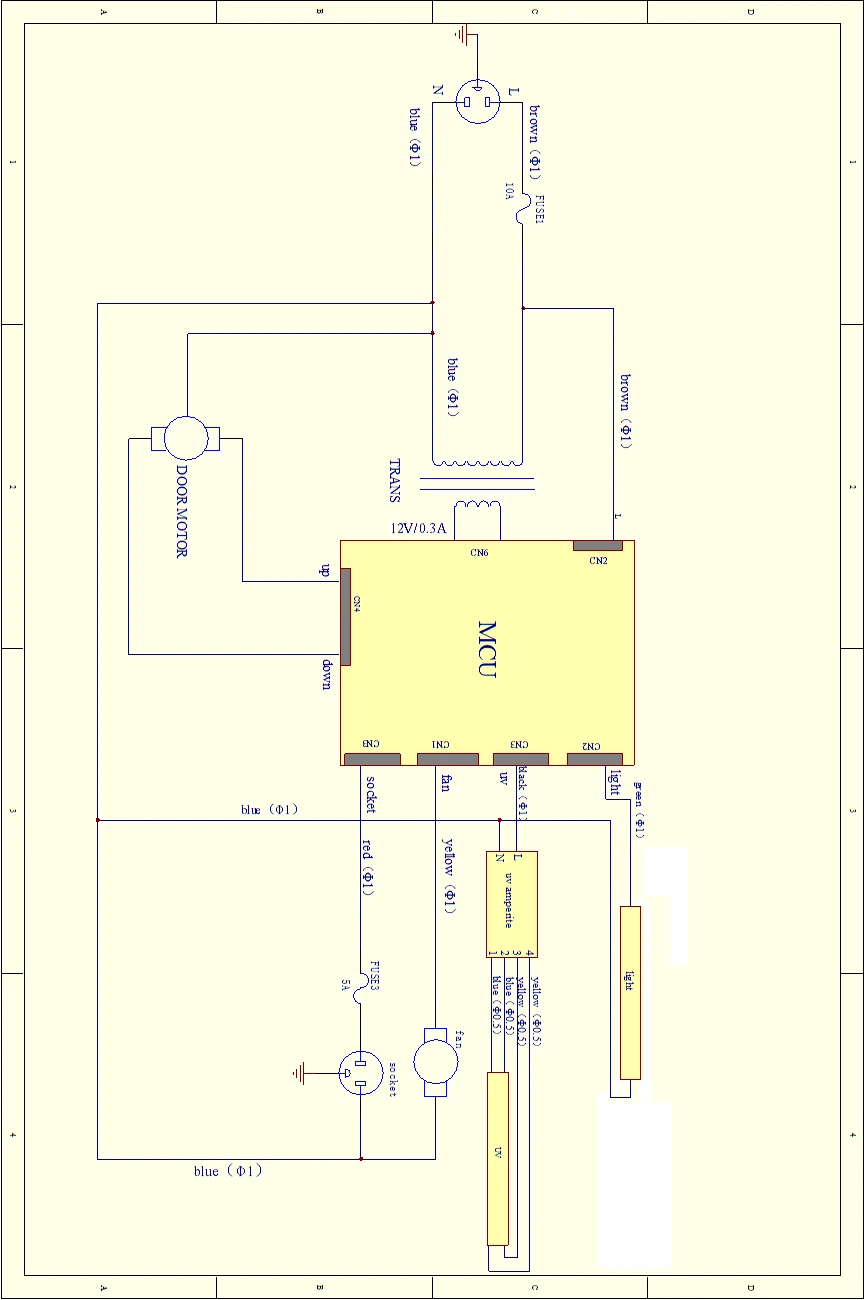
Figure 15
3. Trouble Shooting and Labels
3.1 Common Failures and Solutions
3.1.1 Trouble shooting
Please confirm that the power is well connected, the power cord, the circuit and the fuses are in good condition (without any damage) before trouble shooting the following problems.
Failures | Checking Part | Suggestion |
Fluorescent lamp fail to work | Fluorescent lamp tube | Replace the fluorescent lamp tube |
Circuit | Check the circuit | |
Control panel | Replace the control panel | |
UV lamp fail to work | Fluorescent lamp and blower | Make sure the fluorescent lamp and the blower are turned off |
Lamp holder | Connect the tube and lamp holder tightly | |
Ballast | Replace the ballast | |
Checking according the fluorescent lamp failure step, then confirm. | ||
Button fail to work | Control panel | Make sure the power is well connected and the fuse is in good condition |
Check if the button is broken | ||
Make sure the connecting wire is well connected | ||
Replace the control panel | ||
Blower fail to work | Blower | Replace the blower if it is defective |
Circuit | Check the circuit | |
Control panel | Replace the control panel | |
No electricity in socket | Socket fuse | Check if the socket fuse is broken |
Socket | Check if the socket is broken | |
Circuit | Check the circuit | |
Control panel | Replace the control panel | |
Front window fail to work | Transmission part | Check the transmission connection and lead rail |
Motor of front window | Check the front window motor | |
Circuit | Check the circuit | |
Control panel | Replace the control panel | |
No electricity in equipment | Power supply | Check whether the power supply is well connected |
Power cord | Check whether the power cord is in good condition | |
Fuse | Check if the fuse is damaged | |
Potential transformer | Check whether the transformer works normally | |
Control panel | Replace the control panel | |
Display fail to work | Signal transmission line | Check whether the signal transmission line is well connected |
Display screen | Check whether the screen is in good condition | |
Control panel | Replace the control panel |
Table 6
NOTE: a) The above trouble shooting methods should be done by qualified electricians under safe conditions (cut off power supply). Other components should not be removed. Risk caused by failing to follow those instructions would be responsible by user.
b) Please contact Biobase technical department if a failure could not be traced or solved. Do NOT repair the equipment without a qualified electrician.
c) The trouble shooting and repair of this equipment only could be undertaken by trained and recognized technicians.
d) Please contact Biobase technical department or agent to order required component or part. The model number and the serial number of purchased Fume Hood need to be indicated.
3.1.2. Simple accessories replacement
a) Replace the fuse
Fuse of socket and fuse of neutral wire is located on top of the equipment (refer to picture 13). For replacing the fuse, turn off the power and disconnect the plug. Use a Phillips screwdriver and rotate it anticlockwise to unscrew the fuse holder. Replace the fuse inside the fuse holder and then, use a Phillips screwdriver and rotate it clockwise to screw back the fuse holder. Live wire fuse is also located on top of the equipment, inside the female connector. For replacing the live wire fuse, turn off the power and disconnect the plug. Use a Slotted screwdriver to lever up the fuse holder to open it. Replace the fuse inside the fuse holder and then, press the fuse holder back.
The parameter of the fuse tubes in the round fuse holders are required to conform to labels, that are F5A φ5x20 mm and F10A φ5x20 mm.
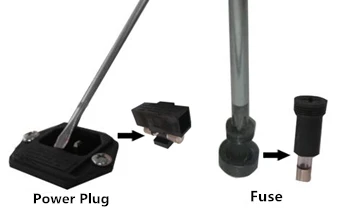
Figure 16
b) Replace fluorescent light
For replacing the lamp tube, press UP button to rise up the front window to the highest position, then turn off the power and disconnect the plug. Remove the power cord of the lamp tube refer to picture 17. Then remove the lamp tube by pulling the small slice on the tube base as shown in the Picture 17. Install a new lamp tube by pushing it in and connecting with the power cord.

Figure 17
c) Replace the UV lamp
The UV lamp tube should change regularly, for example every 600 hours. For replacing the lamp tube, press the UP button to rise up the window to the highest position, then turn off the power and disconnect the plug. Rotate the tube for 90° to remove it and then install a new UV lamp tube by rotating in reverse direction.
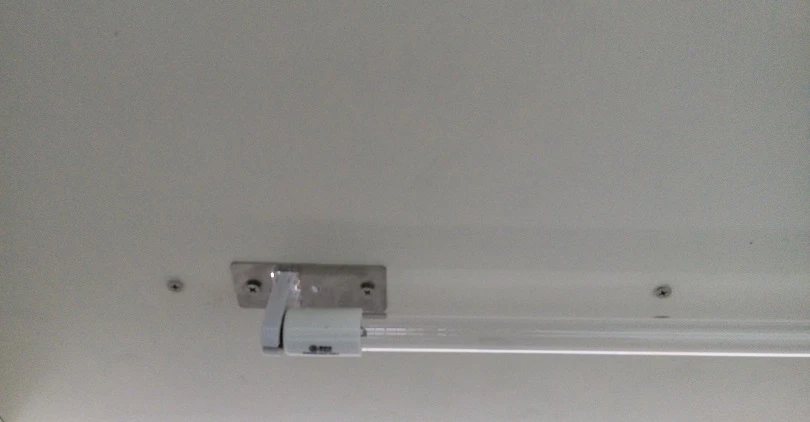
Figure 18
3.2 Label Description
3.2.1 Fuse label
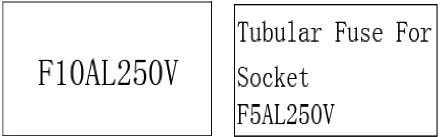
Figure 19
a. Operating area 5A socket fuse label, located under the socket fuse holder
b. 10A power fuse label, located under the female power connector
3.2.2 Ground label

Figure 20
3.2.3 Load requirements label
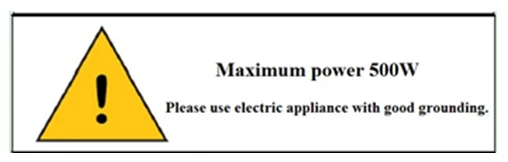
Figure 21
4. Warranty
4.1. Warranty is 12 months from EX-factory date (excluding consumable accessories, UV and Fluorescent lamp, fuse
4.2. Biobase would not be liable for any repair of damage caused by improper operation
4.3. If the warranty has been expired, Biobase would still responsible for repair with relative charges
4.4. Life time of fume hood is 8 years from production date on the label
4.5. Biobase would provide equipment drawings and necessary technical data for maintenance companies or personnel trained by Biobase engineers
Warranty Declaration: One-year Warranty, Life-long Maintenance