
Get Price
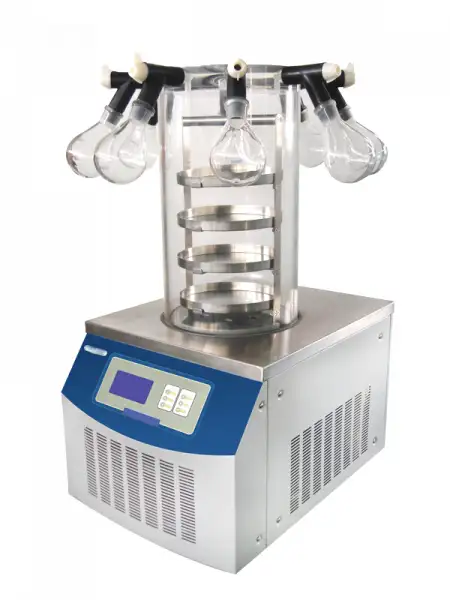
Laboratory Benchtop Freeze Dryer BFBT-103-A
Simple and economical means of freeze drying for stabilization of living material and preservation of fragile substances. Equipped with vacuum freeze drying technology and customizable tray spacing, this is the right product for your small scale freeze drying requirements.
- Condenser, control panel, shelves and trays are made of stainless steel
- Low noise compressor with a long shelf life
- The drying chamber is equipped with organic glass for safety and visibility
- Condenser features pre-freezing function
- Up to 3-Year Product Warranty
- US & EU Compliance Standards
- Door-to-Door Shipping
Technical Specifications
Detailed operating and construction parameters for this model.
| Model | BFBT-103-A |
| Capacity | 1.2 L |
| Condenser Temperature | -55°C |
| Water Holding Capacity | 3-4 /24h |
| Freeze Drying Surface Area | 0.12 m² |
| Pre Freeze Shelf Dimension | φ 200 mm |
| Vacuum Degree | < 10 Pa |
| Pump Flow Rate | 2 L/sec |
| Vial φ 22 | 260 |
| Vial φ 16 | 480 |
| Vial φ 12 | 920 |
| Overall Dimension (mm) | 565 x 420 x (360 + 430) |
| Shelves | 4 |
| Weight | 105 kg |
| Power | 970 W |
| Power Supply | 110-220V, 50/60Hz |
Product Features
Key design, performance, usability, and safety advantages.
Applications Explore common laboratory, research, industrial, and process applications.
Laboratory, Research, Proteins, Organic Tissues, Waste Products, Plant Material, Polymers, Pharmaceuticals, Nutraceuticals, Plant material.
Accessories For Purchase View compatible optional accessories and additional items available separately.
| Name | Description | Temperature |
| Nitrogen inflation valve | ||
| Exhaust filter/ Oil mist filter for pump | ||
| Air inlet filter for pump | ||
| Anti oil return valve for pump | ||
| Electricity heating defrosting | ||
| Electric heating shelf | ||
| Trays | ||
| RS232 and software | Check and keep freeze drying data on computer; control freeze dryer through PC | |
| -80°C Condenser | Minimum condenser temperature as -80°C | Min. condenser temperature as -80°C |
Operating Manual View instructions, operating procedures, safety information, and maintenance guidance.
1. Summary
2. Characteristics and Technical Parameters
3. Conditions In Use
4. Installation and Preparations for Freeze-Drying
4.1 Structure of freeze dryer and name of partition
4.2 Installation of freeze dryer
4.3 Test of freeze dryer
5. Operation of Pre-Freezing and Drying Process
6. Turn OFF Machine Operation
7. Control Operation
8. Notices
9. Common Breakdown and Elimination
1. Summary
The vacuum freeze-drying technology, which is also called sublimation drying, is a technical method that freezes the samples in advance, and then sublimates its moisture in the vacuum state. Goods are easier for long-term preservation after freeze-drying processing. They can be restored to the original state and maintain their chemical and biological characteristics after being watered. So the freeze-drying technology is widely used in medicine, food, chemistry industry and biological products etc.
2. Characteristics and Technical Parameters
1. Main characteristics
◦ SECOP compressor, refrigeration rapid and condenser temperature low.
◦ LCD touch screen control system, simple operation
◦ The control system automatically stores data, and data can be viewed in form of curves. Data also can be output by USB port.
◦ The drying chamber uses transparent acrylic drum. User can clearly view sample state and observe the whole freeze-drying process.
◦ Vacuum pump connected with host by international standard KF quick joint.
◦ Performance of machine is stable, easy to operate and low noise.
2. Technical parameter
◦ Minimum condenser temperature: -50°C(no-load)
◦ Final vacuum: < 10Pa ( no-load)
◦ Tray size: the diameter 200mm, 4 layers
◦ Liquid bulk capacity: 1.2L (10 mm thickness)
◦ Flask: Round bottom flask, 1000ml, 500ml, 250ml, 100ml, each with 2pcs
3. Conditions In Use
1. Ambient temperature in normal working condition: 10°C-25°C. Relative humidity: ≤70%.
Power supply: AC 220V±10%, 50/60Hz.
The working environment should be no conductive dust, explosive and corrosive gases and strong electromagnetic interference.
2. Transport and storage conditions Environment temperature: -40°C~50°C. Relative humidity: ≤93%.
The storage conditions should be well-ventilated, no corrosive gases.
4. Installation and Preparations for Freeze-Drying
4.1 Structure of freeze dryer and name of partition
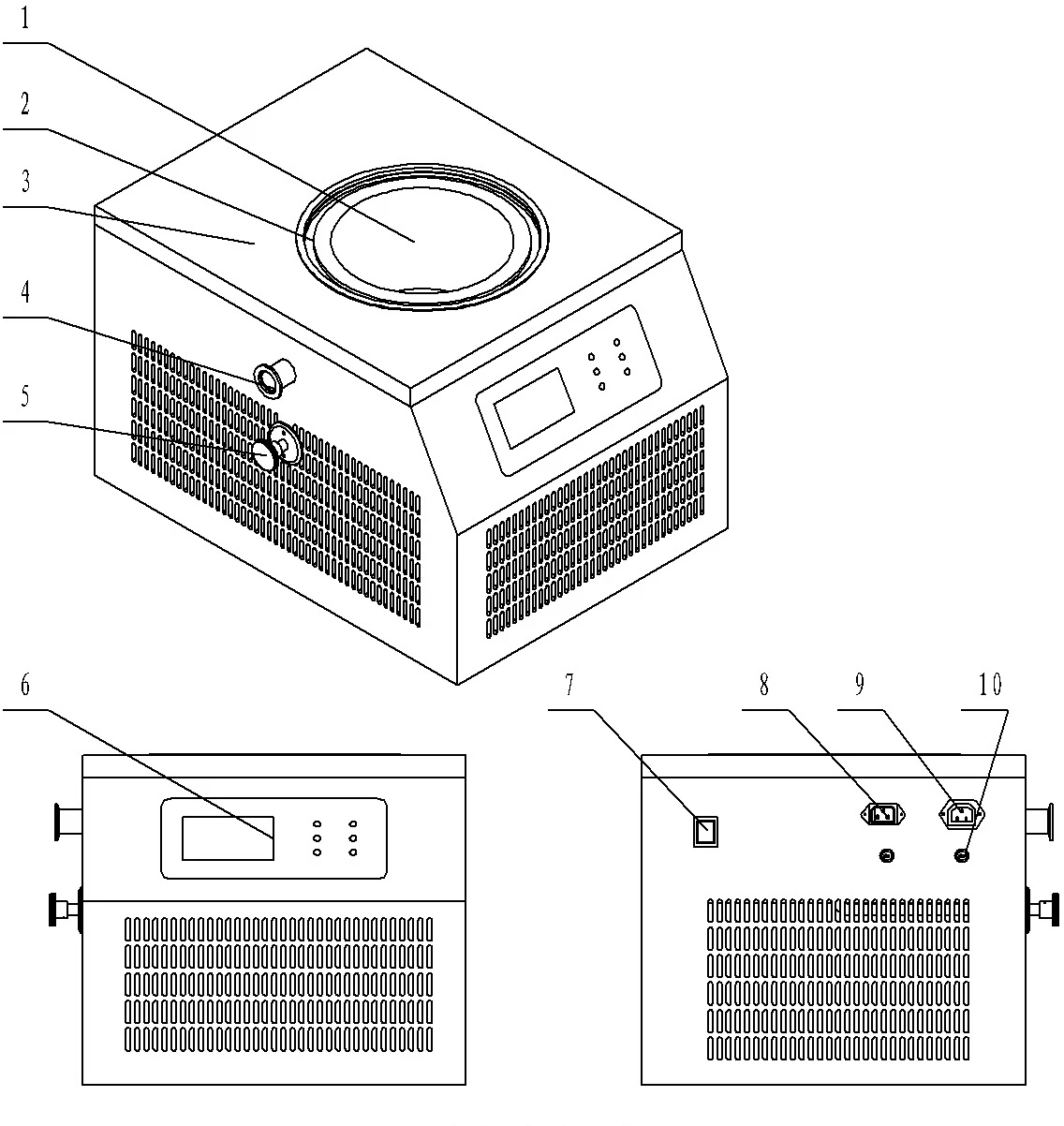
Figure 1
Structure of host
1. condenser
2. sealed ring
3. workbench
4. vacuum port
5. drain valve (air inlet valve)
6. control panel
7. switch
8. general power
9. vacuum pump
10. power fuse
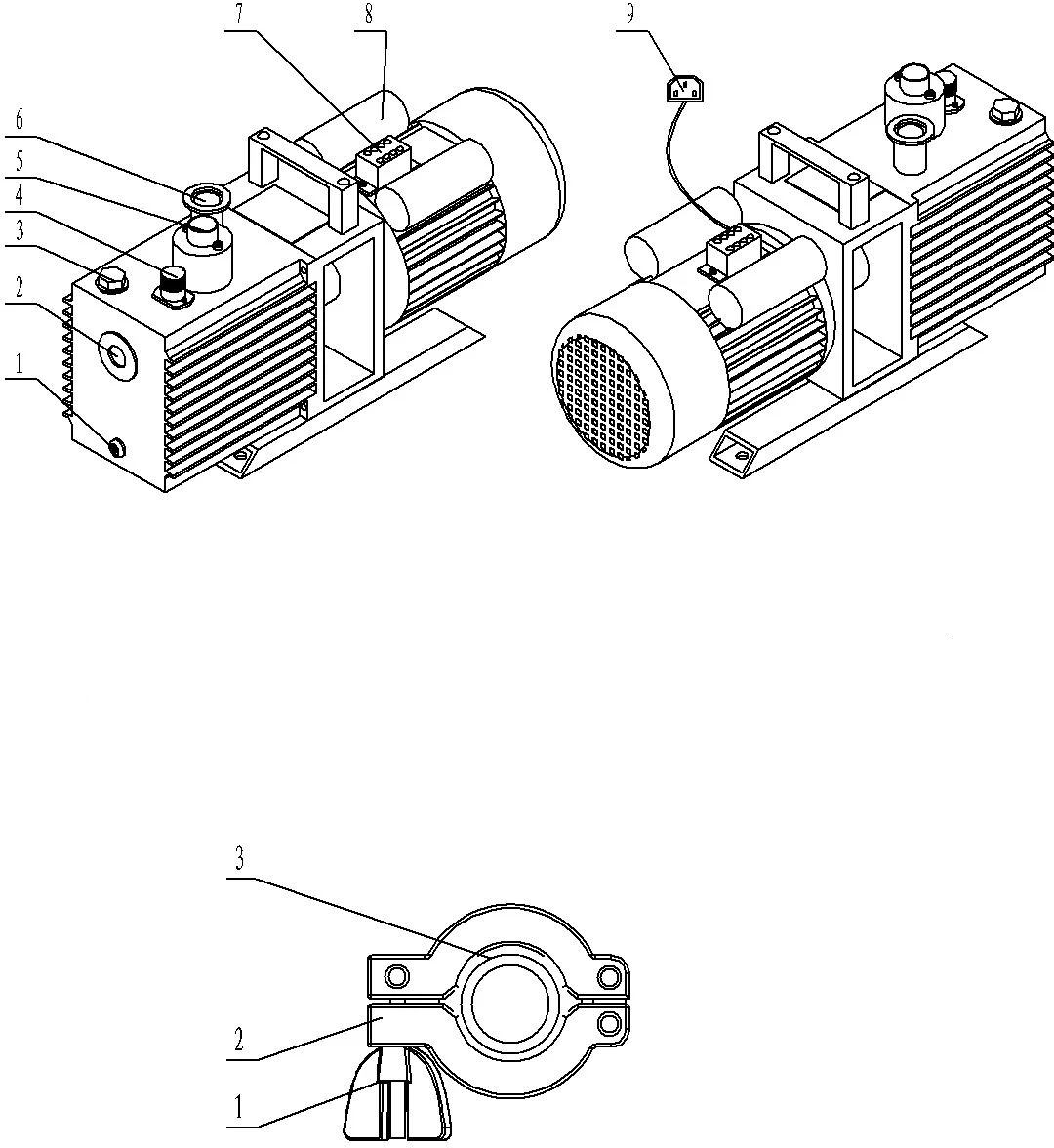
Figure 2
Structure of vacuum pump
1. oil drain
2. oil level glass
3. oil filler hole
4. gas ballast valve
5. exhaust port
6. air inlet
7. connecting terminal
8. capacitor
9. vacuum pump power cord
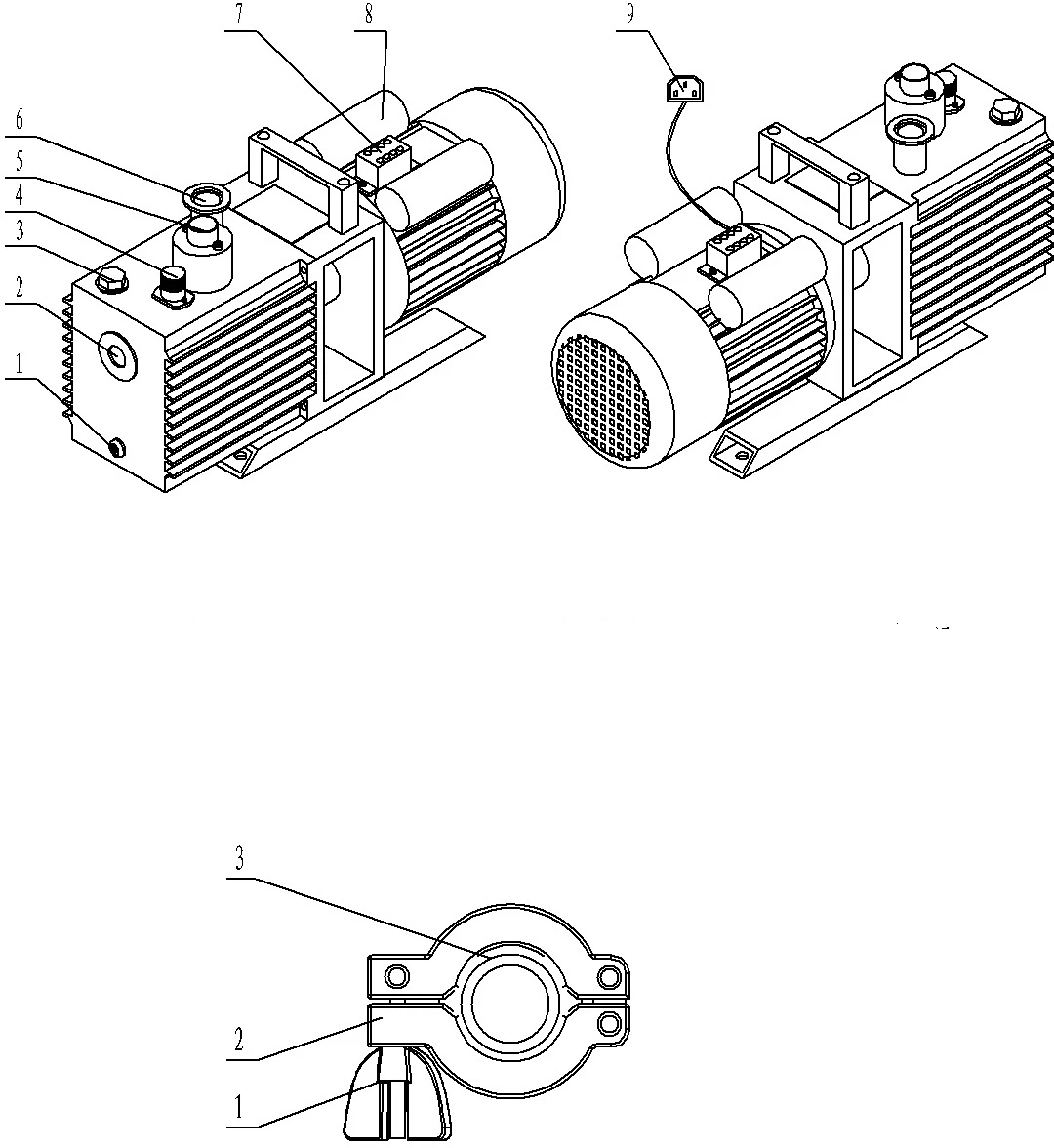
Figure 3
Structure of clamp
1. screw nut
2. support
3. gasket ring
4.2 Installation of freeze dryer
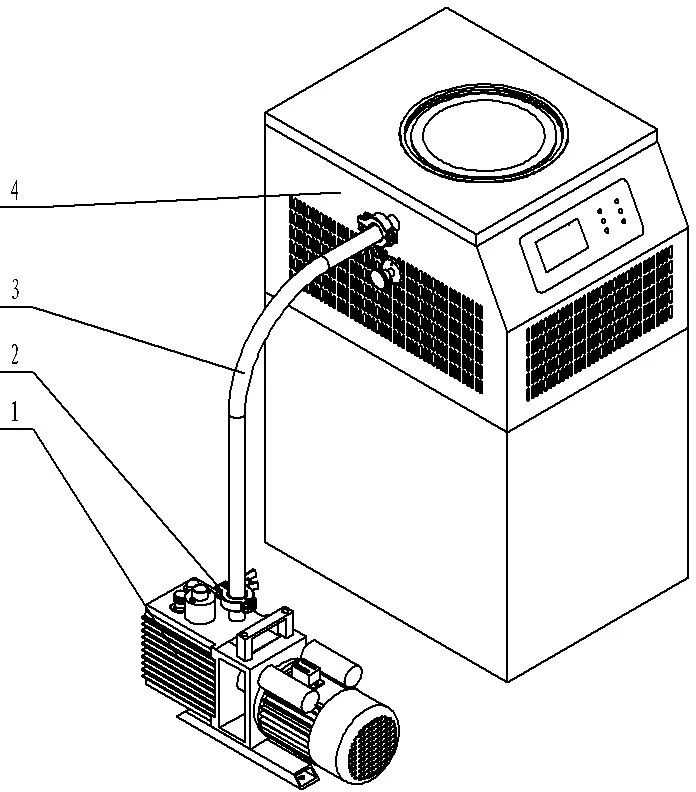
Figure 4
Connection of the device
1. vacuum pump
2. clamp
3. tube that connects host with vacuum pump
4. Host
Installation steps:
1) Check accessories complete and undamaged;
2) Add vacuum pump oil to middle of level glass;
3) Connect the air inlet on pump and tube by clamp; the other end of tube connected with vacuum port on host;
4) Connect "vacuum pump power cord" with "vacuum pump power "interface on host;
5) One end of the power line is inserted into "general power" interface on host; the other end is connected to power supply 220V,50Hz (the power should be connected with ground lead)
6) Turn on switch and test parameters of freeze dryer (final vacuum degree<10Pa, condenser temperature -50°C).Then the device is put into use.
4.3 Test of freeze dryer
Test of condenser temperature
1) Cover the pre-freeze lid
2) Turn on switch, to enter control system. Touch the screen, to go to main interface. Press "compressor" to turn on compressor to test refrigeration.
3) Condenser temperature drops to -50°C within 60 minutes, test is ok.
Test of vacuum degree
1) Press"vacuometer " to turn on vacuum gauge, standard atmosphere is displayed;
2) Put on sealed ring
3) tighten the air inlet valve
4) place organic glass drum, drum bottom full contact with sealed ring.
5) Turn on vacuum pump by pressing "vacuum pump" key. vacuum degree rapidly decline.
6) Vacuum degree goes down below 10 Pa within 10 minutes, test is ok.
7) After finishing tests, open air inlet valve on host to inflate host and restore normal pressure. Then the machine is ready for running.
Notices:
1. There are no obstructions behind and at sides of host within 30cm;
2. Make sure that the vacuum pump oil has been filled before starting up.
5. Operation of Pre-Freezing and Drying Process
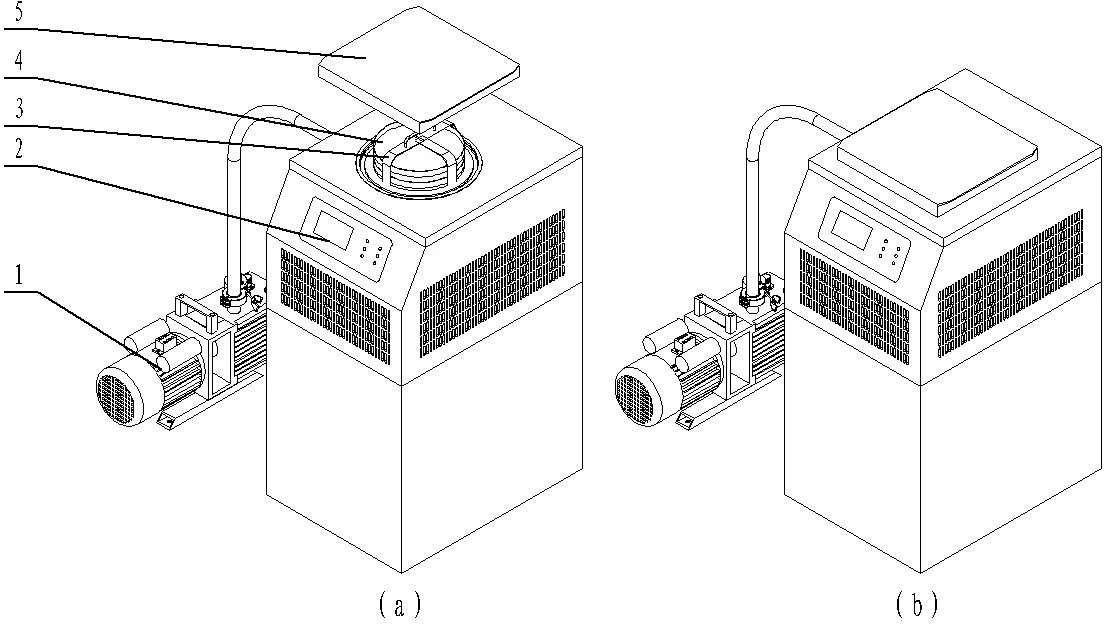
Figure 5
pre-freezing process
1. vacuum pump
2. control panel
3. pre-freeze shelf
4. material tray
5. pre-freeze lid
The general pre-freezing process with steps:
(If you have low-temperature freezer , this process may be canceled. For flasks, user needs to prepare cold trap with spin freezing device)
1. Turn on machine and start compressor. When condenser temperature drops below
-40°C,you begin to freeze material ;
2. Put material into material tray
(liquid directly into tray, solid material and vials evenly put on tray );
3. Put material tray into pre-freeze shelf and put the temperature sensor into material with full touch, to reduce error of sample temperature and actual temperature;
4. Put pre-freeze shelf into condenser;
5. Cover the pre-freeze lid;
6. When temperature of all parts of material drop below eutectic point, this condition will be still keeping about one hour .Then pre-freezing process is over and ready to make drying process.
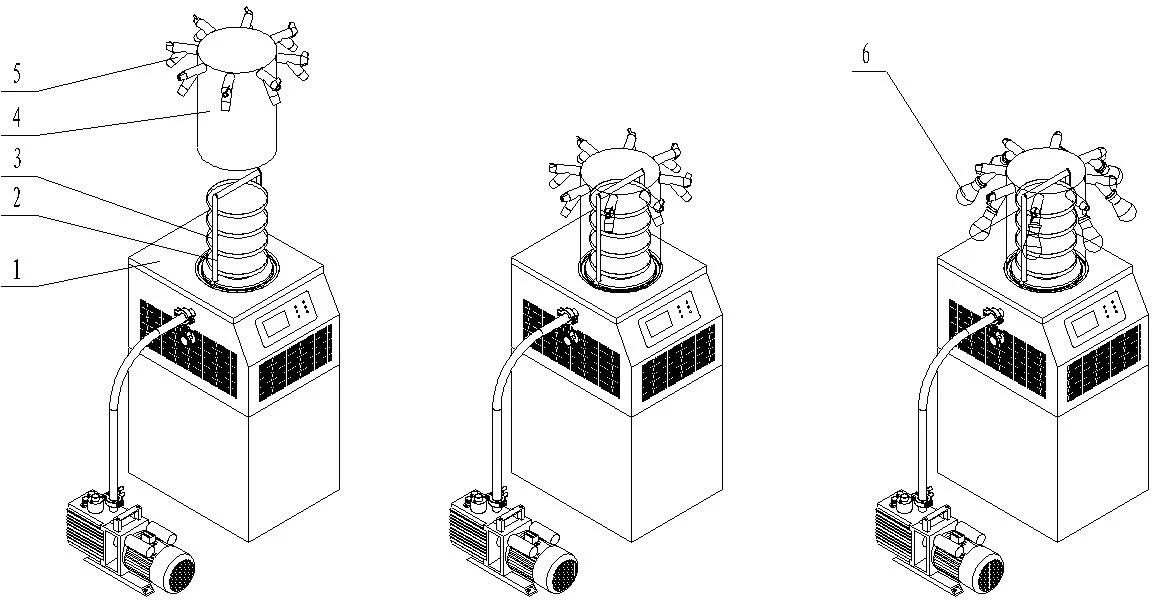
Figure 6
Drying process
1. host
2. drying shelf
3. material tray
4. acrylic drum
5. manifold connection valve
6. Flask
Drying process with steps:
1 . Take out the material from condenser and put trays on drying shelf;
2. Put the drying shelf on condenser (as shown in above diagram); Put temperature sensor into material. Please note that sensor should be taken out through half round hole reserved at side of flange , in order to prevent damage by drying shelf.
3. Check sealed ring intact and without raffle ,put on organic glass drum ; The bottom of drum should be completely in touch with "O" sealed ring.
4. Tighten the air inlet valve on host in clockwise;
5. Turn on vacuum pump and vacuum gauge by touching "vacuum pump" and "vacuometer" on main interface. The vacuum degree declines.
It's normal that the vacuum degree is less than 20Pa during drying process;
6. Connect flask on manifold one by one, and open rubber valve. When material in flask is dry, please close rubber valve and take off flask.
7. Drying time is different for material property. Generally speaking, material should be dry when material temperature reach room temperature.
8. When drying process is over, first open air inlet valve to inflate host, then turn off vacuum pump by pressing "vacuum pump" key. Press "vacuometer" key, the vacuum degree display will vanish. Then, turn off compressor by pressing "compressor" key.
9. Take off acrylic drum and collect dried material.
10. Close drain valve, machine begins to defrost. After finishing defrosting, open drain valve to drain off water. Clean the equipment.
11. When the vacuum pump does not work, please cover the exhaust port to prevent dust.
Notice: a. Compressor can not be turned off in whole freeze drying process;
b. For different materials, freezing time and drying time are not the same ,because of differences in material properties.
6. Turn OFF Machine Operation
1 .Turn off power switch;
2. Unplug the power cord;
3. Clean condenser, drying shelf and organic glass drum and other parts;
7. Control Operation
The control system uses LCD touch screen display, easy to operate and the running status is clear. The system displays sample temperature curve, condenser temperature curve and vacuum degree curve. System adopts a variety of stable measures so that control system runs stable and reliable.
The control system contains following display screen.
1. Turn on switch, system goes into initial interface. Touch the screen center, it enters main interface.

Figure 7
Initial Interface
2. On main interface, touch"compressor",compressor starts to work. Touch"vacuum pump", pump starts to work. Touch"vacuometer",vacuum degree displays.
Touch "real-time curve" for curves check. "History record" for earlier data check.
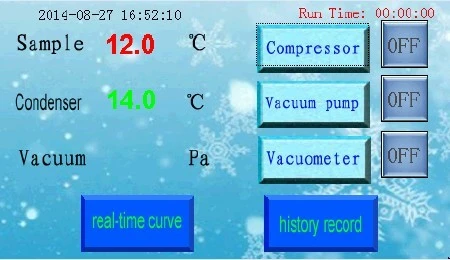
Figure 8
Main Interface
3. Touch"real -time curve", to enter real-time curve interface. On right side, there are "sample","condenser" and "vacuum" buttons to control relative curves.
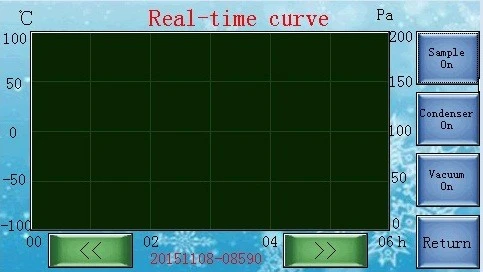
Figure 9
"real-time curve"interface
4. Click"history record"on main interface, it goes into "history select" interface. User can choose specific file, to check this curve,delete it or output it to U flash disk.
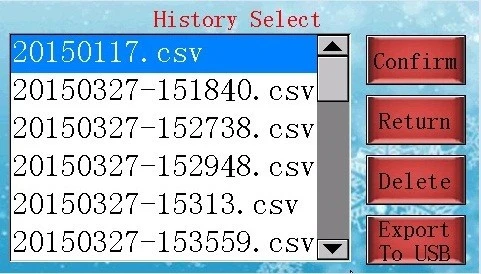
Figure 10
"history select" interface
5. Click "confirm" on "history select" interface, user can see "history curve" interface.
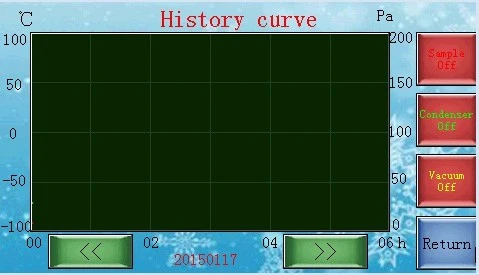
Figure 11
"history curve" interface
6. Click "Delete" button on "history select" interface. Selected file can be removed.
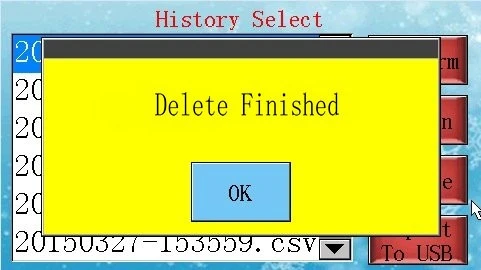
Figure 12
"Delete" interface
7. Click"export to USB"button on "history select" interface.
(U disk capacity should be less than 8G). User needs to insert U disk in advance, then turn on switch to export data. Data can be checked by Excel format.
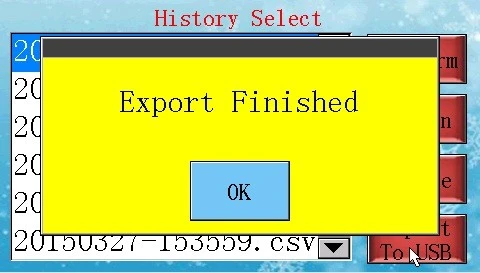
Figure 13
"export to USB" interface
8. System time set
Please press system time place for some seconds, then you can see a system time set screen.
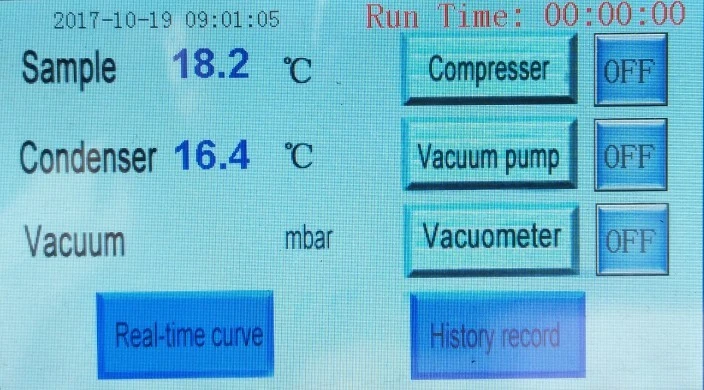
Figure 14

Figure 15
8. Notices
1. The vacuum pump should be put on ground so that it maintains a certain height difference with host(at least 50cm), to prevent oil return if power is suddenly off. If power off, you should open air inlet valve to inflate the host, take out the samples as soon as possible and properly store samples.
2. Working environment temperature ≤ 25°C. Humidity ≤70%.
3. When turn off machine, you should inflate host first, later turn off the vacuum pump to prevent oil return and sample pollution.
4. The organic glass drum is connected with host by "O" sealed ring.
Sealed ring should be kept clean , without organic solvent cleaning; Acrylic drum's touch end with sealed ring should be protected from strike and damage.
5. Grounding power socket must be used.
6. vacuum pump oil need change regularly after working 200 hours continuously.
7. Please don't frequently turn on and turn off power supply and compressor. If compressor stops working because of wrong operation, you need to restart the compressor after waiting for at least 3 minutes.
9. Common Breakdown and Elimination
1. The vacuum degree can not achieve below 15Pa.
◦ Check the connection between vacuum pump and host, to make sure clamp is tight
◦ Check whether acrylic drum bottom is clean, whether there is damage on touch
◦ surface
◦ Check whether the "O" sealed ring is clean , whether its placement is correct.
◦ Check whether the vacuum pump works normally and whether the pump oil is clean .
◦ Check whether the air inlet valve is screwed tightly
2. High condenser temperature
Ambient temperature is too high , leading to bad heat dissipation.
Please place the machine in proper environment with well ventilated condition.