
Get Price
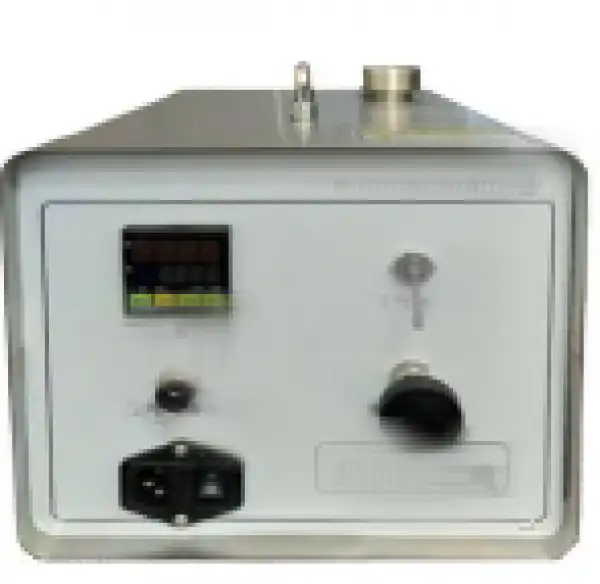
Aerosol Generator BKF-3701
- Wide airflow range (500-65,000CFM)
- Adjustable dust concentration (0-100 micrograms per liter)
- Large capacity dust production (unpacking can be detected for 4 hours)
- Up to 3-Year Product Warranty
- US & EU Compliance Standards
- Door-to-Door Shipping
Technical Specifications
Detailed operating and construction parameters for this model.
| Model | BKF-3701 |
| Airborne particle output range | 500-65,000 cubic feet per minute |
| Suspended particle concentration | 100 MCG/L at 6,500 cubic feet per minute flow time |
| Suspended particle concentration | 10 MCG/L at 65,000 cubic feet per minute flow time |
| Generation type | Heating chamber |
| Compressed air | No need |
| Compressed gas (inert gas) | 20 cubic feet per hour at 50psi |
| Gas type | Particles of multiple diameters (cold) |
| Size | (35cm L X 25cm W X25cm H) |
| Weight | 9.1 KG |
| Voltage | 110 VAC / 60 Hz or 220 VAC / 50hz |
Product Features
Key design, performance, usability, and safety advantages.
Applications Explore common laboratory, research, industrial, and process applications.
The suspended particle generator is designed to provide excellent performance and ease of operation. It is an ideal tool for demonstrating or testing HEPA efficient filtration systems. It needs to be installed in an air flow system ranging from 500 to 65,000 cubic feet per minute, and an inert gas source and a 120/240 volt, 750 watt power supply environment.
Has control and display functions on the front panel. This is a high-capacity suspended particle generator that can operate for 4 hours without refilling.
Can produce a uniform size distribution of airborne particles, the principle is by adding a certain amount of suspended particle source liquid in a large hot area, the liquid is evaporated and recombined, at only 5 pounds of pressure, through a small amount of inert gas sent to form a variety of diameters of airborne particles. When combined with photometers such as TDA-2G or TDA-2H, TDA can provide enough suspended particles to measure filtration systems (flow rates range from 500 to 65,000 m3 / min) or concentrations of less than 100 MCG/L, increasing the sensitivity of the photometer can also test for leakage.